

Accession, succession and dynastic chronology to the imperial throne of Mandé
Accession, succession and dynastic chronology to the imperial throne of Mandé
The Accession to the Imperial Throne of Soundjata Keita from 1235 to 1255
Upon the death of Naré Maghan Konaté, king of Niani, his eldest son Dankaran Toumani, born of Sassouma Bérété, was designated as heir to the throne. As for Soundjata, son of the second wife Sogolon Kondé, he was excluded from power despite the prophecies that had announced since his birth that he would be the chosen one of Mandé. Rejected by the court, despised by the king's first wife, Soundjata grew up in exile with his mother, with no apparent ambition, but carrying a destiny that the elders had not forgotten.
While Mandé gradually sank under the threat of Soumaoro Kanté, king of the neighbouring kingdom of Sosso, Dankaran Toumani proved incapable of resisting the invader. Faced with the tyrant's offensive, he chose to flee and took refuge in Kissidougou, thus abandoning not only the capital but also his people. He lost all legitimacy in the eyes of the traditional chiefs. A king who does not defend Mandé, they said, cannot be its guardian. In Mandingo custom, the throne is not personal property: it is a charge, entrusted by the people and the elders to those who are fit to bear it.
The chiefs of the great families of Mandé — Kamara, Traoré, Cissé, Condé, Diabaté and other noble lineages — then gathered to decide the future. They understood that Mandé, humiliated and deprived of a king, had to be saved by someone worthy. Their choice naturally fell on Soundjata, in exile in the kingdom of Mema. Despite his distance, he belonged to the royal line; through his mother Sogolon, the buffalo woman, the woman chosen by the diviners to give birth to a saviour, he embodied a mystical and prophetic legitimacy, rooted in Mandé spirituality. The chiefs therefore sent a delegation to recall him to his duty as a legitimate claimant to the vacant throne, to "take his inheritance" — expressed as KEYETA or KIENTA, which later became KEITA.
Soundjata answered the call of his people and raised an army of allies and supporters from all the peoples of Mandé. He confronted Soumaoro Kanté at the famous Battle of Kirina in 1235, which he won thanks to his strategic intelligence, his courage, and the loyalty of his men. This victory marked the liberation of Mandé, but also the beginning of a new imperial order.
After the victory, the chiefs gathered at Kurukan Fuga to recognise Soundjata as Mansa. He did not proclaim himself king: he was invested by all the traditional chiefs assembled in the Gbara, a great customary assembly founded to guarantee balance between clans, castes and territories. It was also at Kurukan Fuga that the Mandé Charter was proclaimed, the moral and political foundation of the Empire, affirming the principles of liberty, human dignity, solidarity and justice. This charter would guide the Empire of Mali for centuries.
The story of Soundjata thus establishes a clear and still living rule in the Mandé tradition: the throne does not necessarily go to the eldest by blood, but to the one who is recognised by the customary chiefs, supported by the people, capable of ensuring the stability of the kingdom and embodying the values of Mandé. Lineage remains important, but the recognition of the Gbara, personal merit, service to the people and spiritual continuity are equally decisive. When a sovereign abandons his responsibilities or betrays the foundations of Mandé, he can be replaced by another legitimate heir, according to the will of the elders.
Thus, in Mandé, imperial legitimacy is based on memory, custom, the recognition of the chiefs, and fidelity to the values inherited from Kurukan Fuga. It is not birth alone that makes the sovereign, but the assent of the wise, nobility of spirit, and the ability to answer the call of Mandé in times of crisis.
The story of Soundjata Keita establishes a clear rule, still valid for legitimate customary successions in Mandé:
"The throne goes to the one who is legitimised by lineage, recognised by the traditional chiefs, supported by the people, and capable of defending the values and integrity of Mandé."
This rule rests on four pillars:
Royal lineage (paternal or maternal): The claimant must descend from the founding lineage of Mandé.
Recognition by the Gbara (the chiefs): Authority is not taken; it is given by the voice of the elders.
Personal merit: Courage, wisdom and the ability to unite take precedence over birth order.
Service to the people: The king is not master, but guardian of Mandé, guarantor of justice and the common good.
Mansa Ouali Keita, biological son of Soundjata Keita 1255-1270
Upon the death of Soundjata Keita around 1255, the Empire of Mali had just been born from the ashes of the Sosso kingdom. The new order he had established at Kurukan Fuga had laid the foundations of an organised state, based on justice, equity and the memory of the ancestors. His son, Wali Keita (also spelled Uali or Mansa Wali), succeeded him on the imperial throne. This was the first transmission of dynastic power in the history of Mali, a decisive step that would confirm that the empire founded by Soundjata was not only the fruit of one man, but indeed of a legitimate lineage.
Wali was the biological son of Soundjata Keita, born to one of his official wives. His designation as heir was recognised by the Gbara, the imperial council, whose mission was to ensure the continuity and balance of power. His accession to the throne was uncontested, as he fulfilled two fundamental conditions in the eyes of the traditional chiefs: on the one hand, he belonged to the direct line of the founder, thus ensuring dynastic continuity; on the other hand, he had been trained in command and respected the principles of Kurukan Fuga. He embodied stability and heritage.
The reign of Wali Keita, which lasted from 1255 to 1270, was marked by the consolidation of the empire. He continued the centralisation work begun by his father, strengthened the institutions of the Gbara and ensured the unity of the conquered provinces. He also made the pilgrimage to Mecca, becoming the first Mansa to make an official commitment to the Islamic faith, while maintaining the traditional balances of Mandé. His international recognition reflected on the empire, which gained prestige in the Muslim world.
The case of Wali reveals an important rule in Mandingo tradition: dynastic succession is possible when the direct heir of the deceased sovereign is recognised by the council of elders as fit to govern and respectful of the established order. It is not enough to be the king's son; one must also be able to ensure the moral and political heritage of one's ancestors. The agreement of the Gbara, based on the consensus of the great families, remains an essential element, even in a transmission by blood. Thus, in the imperial tradition of Mandé, succession legitimacy rests on a dual foundation: direct lineage (royal blood) and political recognition by the traditional chiefs. This principle guarantees continuity without engendering hereditary tyranny: a designated heir can be replaced if he does not respect the foundations of Mandé. But if he embodies the balance between heritage, merit and faith, then his rise to the throne is welcomed as a blessing.
"Dynastic hereditary succession legitimised by customary recognition"
In the case of Mansa Wali Keita, this is a patrilineal succession (transmitted from father to son), but not automatic: it requires validation by the traditional chiefs assembled in council (the Gbara).
This type of succession, specific to the imperial traditions of Mandé, could also be described by the expression:
"Dynastic-customary succession" or "customary dynastic law succession."
It is distinguished from:
automatic primogeniture (where only the eldest inherits unconditionally),
and pure meritocracy (where only the most capable are chosen, regardless of blood),
because it combines legitimate lineage and validation by customary institutions.
The cases of Ouati Keita (1270-1274), presumed adoptive brother of Ouali (son of one of Soundjata's generals), and of Khalifa Keita (1274-1275), third presumed adoptive brother of Ouali (son of one of Soundjata's generals)
In the history of the Empire of Mandé, succession to the throne did not always follow a strict line of biological descent. After the reign of Mansa Ouali Keita, direct son of Soundjata Keita, the Empire experienced a phase of dynastic fragility, marked by internal tensions and uncertainties over the legitimacy of power. It was in this context that Wati and then Khalifa Keita were enthroned, two adopted sons of Soundjata according to a pre-existing custom. Indeed, well before the birth of a biological heir, Soundjata had established a political practice of adopting and training the sons of his generals and companions in arms. This tradition aimed as much to ensure their loyalty as to prepare a competent and faithful succession, true to the spirit of Kurukan Fuga. Wati and Khalifa, raised at court as sons, were the heirs of this imperial strategy, shaped in the shadow of the founder to embody a possible continuity of power. After Ouali's reign, their adoption and training were perceived as sufficient legitimation by the Gbara, which successively recognised them as Mansa. Wati Keita, though not very charismatic, reigned without major controversy. His limited authority and passive management, however, allowed a provisional maintenance of the imperial order.
The situation changed radically with his successor, Mansa Khalifa Keita. Despite identical training and recognised adoptive legitimation, Khalifa quickly descended into governance marked by brutality and arbitrariness. He showed unheard-of violence against his opponents, despised the advice of the Gbara, persecuted the nobles and deeply weakened the institutions of Mandé. Chroniclers report acts of gratuitous cruelty, authoritarian decisions, and a manifest break with the ethics of justice established by Soundjata. This tyranny of Khalifa Keita caused a real political rupture. The Gbara and the provincial chiefs, outraged by his behaviour, put an end to his reign. He was deposed or assassinated according to certain oral traditions. This tragic experiment highlighted the limits of the adoptive model when not accompanied by imperial virtue. Succession then returned to a more direct line, with Mansa Abubakari Keita, guaranteeing a return to dynastic order and institutional balance.
The brief adoptive succession of Wati and Khalifa Keita thus constitutes a unique episode in the imperial history of Mandé: it illustrates the system's ability to adapt to crisis contexts, but also the possible deviations when the spirit of Mandé is betrayed. The tyranny of Khalifa marks a historical warning: without moral rectitude, even the founder's heritage can become a source of chaos.
The case of Mansa Abou Bakari I from 1275-1285
Following the reign of Wali Keita, biological son of Soundjata Keita, the imperial dynasty of Mandé entered a phase of consolidation marked by internal power struggles between the different royal branches descended from Soundjata. Among the most significant figures of this period is Mansa Abubakari I, whose rise to the imperial throne represents a crucial precedent in the history of Malian succession.
Abubakari I was not the son of a Mansa, but the grandson of Soundjata Keita through his daughter Kolonkan Keita. In the imperial tradition of Mandé, this type of succession — through the royal maternal line — was not systematic but remained possible when the legitimacy of the maternal ascendant was uncontested and the individual had gained recognition and support within the Gbara. Kolonkan Keita, as the direct daughter of Soundjata, enjoyed immense prestige. She herself was considered a sacred matriarch in Mandé traditions, and her descendants were held in high esteem.
The choice of Abubakari I as sovereign, between approximately 1270 and 1285, thus fits into a model of succession by uterine lineage legitimised by the customary assembly. This is a fundamental point of the Malian power structure: the royal lineage is not limited to paternal transmission, but can be assured by maternal descent, as long as there is a direct link with Soundjata and the person is recognised by the chiefs of Mandé as worthy of reigning. Historically, the accession of Abubakari I shows that succession within the Empire of Mali was neither rigid nor strictly patrilineal. On the contrary, it responded to a dynastic logic based on customary legitimacy, recognition by noble families, and the ability to preserve the balance of the kingdom. This flexible but coherent system made it possible to avoid bloody wars of succession: by integrating both lines — male and female — descended from the founder Soundjata, Mandé guaranteed a harmonious continuity of power.
Abubakari I's authority was recognised throughout the Empire. His reign, although relatively short, confirmed the existence of an implicit imperial rule: any direct descendant of Soundjata Keita, through father or mother, can accede to the throne of Mandé, provided they are recognised by the Gbara and demonstrate their ability to ensure the stability and unity of the kingdom. This rule underlines the political flexibility of medieval Mandé, based not on dynastic absolutism, but on a balance between blood heritage, merit and customary recognition. The example of Abubakari I is fundamental to understanding the plasticity of Malian customary law regarding imperial succession. It offers a formal precedent for any legitimation through the maternal branch, particularly in cases where the link with the founding lineage is attested and recognised by traditional authorities. This case finally shows that Mandé, far from being a rigid monarchy, was a political society where the throne could be entrusted to those who, by blood as by values, represented the legitimate continuity of the founder Soundjata Keita.
"Any direct descendant of the founder Soundjata Keita through the maternal line, descended from the founding sovereign, can accede to the imperial throne of Mandé, provided they obtain the recognition of the Gbara and demonstrate their moral and political ability to embody the unity of the Empire."
Decomposition of the rule:
Descent through the mother: The blood of Soundjata transmitted by an imperial daughter is considered to carry hereditary legitimacy.
Customary legitimacy: The individual must be validated by the supreme customary body (the Gbara), which confers a political and moral foundation for succession.
Personal capacity: Beyond blood, the successor must embody the values of Mandé (justice, bravery, unity) and be fit to govern.
Legal anteriority: This model was recognised in the case of Abubakari I (c. 1270–1285), successor through his mother Kolonkan Keita, daughter of Soundjata.
Historical argument: Matrilineal lineage and succession to power in the Empire of Mali
Ibn Khaldoun (1332–1406) – Kitāb al-ʻIbar (Book of Examples)
Ibn Khaldoun, a Maghrebi historian and sociologist of the 14th century, never visited the Empire of Mali, but he provides an analysis based on indirect testimonies, within the broader framework of his study of power dynamics and the cycles of civilisations. Regarding succession within the Malian imperial dynasty, he reports:
"Sovereignty over the land of the Blacks belongs to the Mali dynasty. [...] The throne passes to a brother or an uncle when the king's son is not deemed capable. This people has a tradition of choosing the most worthy among the members of the royal family."
This observation highlights a flexibility inherent in the Malian succession system: accession to the throne was not based solely on paternal primogeniture, but also on the recognised ability of the claimant to govern. In this logic, legitimacy derives as much from competence as from blood, which leaves room for a more inclusive interpretation of dynastic law, including through collateral or maternal lines in some cases.
Ibn Battûta (1304–1377) – Rihla (The Journey)
Ibn Battûta, who travelled to Mali in 1352-1353, describes Malian society and institutions with a more direct eye, as he saw the kingdom's practices himself. Regarding succession and titles, he emphasises the importance of the existence of a council of elders, and observes how major decisions were made by collective authorities and consulted before any action, notably during the designation of the sovereign.
"Succession to the throne is governed by a council of notables, which decides on the suitability of the successor, even if the throne belongs to the royal family. Members of the family are judged according to their merit, and the successor is not necessarily the king's son."
This reinforces the idea that legitimacy to power is linked to a collective consensus within the authorities and the elders, and not solely to a patriarchal succession rule.
Al-ʿUmari (1301–1349) – Masālik al-abṣār fī mamālik al-amṣār
Al-ʿUmari, an Egyptian geographer and chronicler of the 14th century, was interested in the political, economic and cultural aspects of the Empire of Mali, notably through accounts gathered from witnesses of Mansa Musa's pilgrimage to Cairo. In his work, he reports:
"The king of Mali distinguished himself by his piety, generosity and learning. [...] This king did not accede to the throne by direct inheritance, but by legitimate succession within his family. [...] He was the nephew of the previous king."
This testimony underlines that Mansa Musa, one of the most illustrious sovereigns of the Empire of Mali, was chosen not solely for his lineage, but for his recognised qualities and the family legitimacy he embodied. It is significant that he was the nephew of the previous king, a detail that reinforces the idea of a succession model based on ability and recognition by the elites, rather than on strict paternal primogeniture. This tradition of meritocratic evaluation, integrated into a dynastic framework, shows the flexibility of Mandingo institutions in choosing their sovereigns.
Al-Bakri (1014–1094) – Kitāb al-Masālik wa al-Mamālik
Al-Bakri (1014–1094), an Andalusian geographer of the 11th century, remains one of the first authors to have documented the kingdoms of West Africa in his Kitāb al-Masālik wa al-Mamālik. Although he was not a contemporary of the Empire of Mali, his writings concern the kingdom of Ghana, often considered a political and cultural precursor of imperial Mandé.
In his work, Al-Bakri describes a matrilineal succession mode:
"The king never dies without his successor having been designated. This successor is not his son, but his sister's son. Thus, power passes through the maternal line."
This testimony sheds light on a tradition of power transmission through the maternal line in the Sahelian region before complete Islamisation. Although this rule was attested in ancient Ghana, and not systematically applied throughout Mandé, it underlines the symbolic and political importance of women in pre-imperial West African dynasties.
Some anthropological research and oral traditions of Mandé also mention forms of dynastic recognition based on the maternal line, notably in the consolidation of alliances between noble families. Thus, far from being an anomaly, maternal ancestry can be understood as a legitimate component of a broader dynastic system, rooted in the plural and evolving history of Mandé.
Al-Idrīsī (1100–1165) – Nuzhat al-mushtāq fī ikhtirāq al-āfāq (The Book of Roger)
Al-Idrīsī, a famous Andalusian geographer of the 12th century, offers one of the oldest testimonies on the political systems of West Africa. Although he primarily refers to pre-imperial kingdoms such as that of Ghana, his observations are historically valuable for understanding the regional political traditions that may have influenced the formation of the Empire of Mali.
He notes:
"Among them [the sovereigns of West Africa], power does not go to the king's son, but to the one who is born of the king's sister. They consider this the only way to ensure the continuity of the royal blood."
This statement underlines the importance of maternal lineage in succession dynamics. Even if it refers to a period prior to the rise of imperial Mali, it sheds light on a potential cultural continuity in lineage organisation and the logic of power transmission. Indeed, the idea that the maternal line guarantees the authenticity of royal blood appears as a fundamental principle in several Sahelian societies before and sometimes during the progressive Islamisation of the region.
Conclusion – A dynamic and meritocratic model of succession in the Mandingo kingdoms
The cross-analysis of the accounts of Al-Bakri, Ibn Khaldoun, Al-ʿUmari and Al-Idrīsī reveals a model of succession that is neither strictly hereditary nor exclusively patrilineal. This system rests on two pillars: dynastic legitimacy (often linked to the maternal line) and recognition of merit, evaluated by councils of elders and elites.
It therefore appears that, both in the kingdoms prior to the Empire of Mali and under certain Mandingo reigns, succession could fall to a nephew, brother or uncle of the king, depending on his competence and ability to govern. This flexibility undoubtedly contributed to the political stability and longevity of certain dynasties, ensuring dynastic continuity without sacrificing the requirement of leadership.
Thus, the maternal line, far from being marginal, constituted a structuring axis of royal power, which offers a traditional foundation to those who today claim it not as exclusive heirs, but as guardians or protectors of an imperial memory shaped by these principles.
The Theory of Professor Francois Xavier Fauvelle of the Collège de France on the Mansas who succeeded Abou Bakari Keita I
Professor François-Xavier Fauvelle, a French historian of international renown, is an essential reference in the field of the history of pre-colonial Africa. Holder of the Chair of History of African Worlds at the Collège de France, one of the most prestigious European academic institutions, he is recognised for his innovative and rigorous work on ancient African civilisations, and in particular on the Empire of Mali. Author of several major works, including the highly influential The Golden Rhinoceros: Histories of the African Middle Ages, Professor Fauvelle strives to accurately reconstruct the political, social and intellectual richness of the great medieval African empires. His research is based on archaeology, medieval Arab sources, African oral traditions, and a critical reading of travellers' accounts of the era.
In his work on the Empire of Mali, Professor Fauvelle highlights the complexity of the rules of succession to the imperial throne. He insists that the transmission of power was not solely through the direct paternal line, but could also operate through maternal descent, notably through royal women, daughters of the founder Soundjata Keita. It is in this context that he analyses the figure of Mansa Abubakari I, who supposedly succeeded Wali Keita towards the end of the 13th century. Professor Fauvelle considers it plausible, according to Mandé traditions and dynastic logics, that this sovereign was the son of Kolonkan Keita, daughter of Soundjata. This case clearly illustrates that imperial heritage could pass through direct maternal lineage, as long as this lineage was recognised by the customary authorities, in particular the Gbara, the council of nobles, dignitaries and traditional chiefs of Mandé. Thus, the work of Professor François-Xavier Fauvelle confirms that there exists in the imperial history of Mandé a legitimate and attested precedent of accession to the throne by a descendant of Soundjata Keita from the maternal line. This succession model reinforces the validity of dynastic claims based on lineage through an imperial daughter, as long as they are accompanied by traditional and moral recognition.
According to Professor François-Xavier Fauvelle's analysis, it is historically possible that Abubakari I, successor to Khalifa Keita, was the grandson of Soundjata Keita through his daughter Kolonkan. This opens the way to a tradition of dynastic uterine succession, in which the throne goes to a direct descendant through an imperial daughter, provided their legitimacy is recognised by the Gbara.
This hypothesis is reinforced by the fact that after Abubakari Keita I, according to a hypothesis of Professor Fauvelle, imperial succession seems to continue within this same descending branch, which suggests the establishment of a dynastic lineage descended from Abubakari Keita, the "Abubakrids", potentially including the famous Mansa Musa. He would thus have been the ancestor of an imperial House of Mandé post-Soundjata, legitimate according to Mandé customs.
Attempts to reconstruct genealogical tables by various world specialists of the Empire of Mali

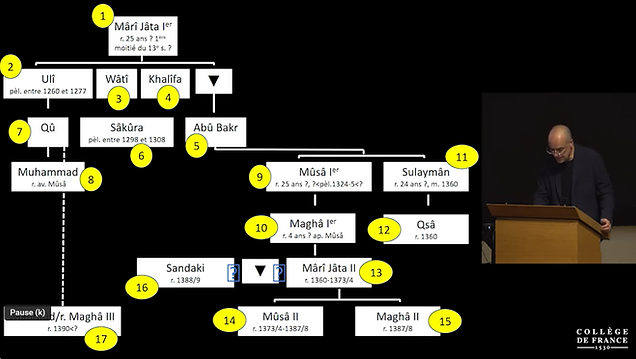


Extract and conclusion from academic correspondence received by the secretariat of the House of Mandé between 2 and 3 May 2025
"Although, personally, I would be much more reserved than you regarding the historical authenticity of the Manden Charter, the questions you ask about the modes of legitimation of power in the kingdom of Mali are excellent questions."
Extract from a private correspondence with the Secretariat of the House of Mandé
In a recent exchange, a distinguished historian and specialist in medieval Africa, author of reference works, shared his thoughts on the research conducted by the House of Mandé. He welcomed the interest of the study on the modes of legitimation of power within the Empire of Mali, while adding some methodological nuances, particularly concerning the historical authenticity of the Manden Charter.
Addressing the question of legitimacy, he pointed out that several lineages, not only the Keita, had been able to exercise sovereignty within Manden over the course of history. He also mentioned that imperial succession was not based solely on hereditary transmission, but that different principles could alternately come into play, as evidenced by the contradictions found in Arab sources. He also expressed keen interest in the comparative approach between the system of legitimation of power in the Empire of Mali and that of the Holy Roman Empire, a comparison he found relevant and enriching.
"As for the principle of succession, I agree with you there as well: it seems to me that several principles alternated, as can be seen in the contradictions of the Arab sources."
Extract from a private correspondence with the Secretariat of the House of Mandé
As part of its research, the House of Mandé has undertaken a thorough examination of the different forms of accession to the throne and the mechanisms of legitimation. This examination has been carried out rigorously, taking into account the legitimacy criteria derived from Mandingo tradition, available written sources, and comparative observations with other imperial systems. The objective is to ensure that each current phase of recognition fully respects the historical principles: dynastic heredity, customary recognition, approval by the Gbara (the assembly of traditional chiefs), and anchoring in the founding values of the Empire. Thus, at the end of this methodological process, the House of Mandé ensures that each contemporary step of legitimation "ticks all the boxes" of the traditional model of imperial succession. The House of Mandé wishes to express its sincere gratitude to this historian for his valuable observations, which confirm the importance of maintaining a rigorous and open research approach, combining oral, written and comparative sources.
The elective or semi‑elective system of the Empire of Mali: The Role of the Gbara


Comparison between the Malian elective system and that of the Holy Roman Empire
The Empire of Mali and the Holy Roman Empire, although distinct in their cultural and geographical contexts, present notable similarities in their mechanisms for legitimising imperial power. These two systems, despite their historical and geopolitical differences, evolved around principles of dynastic succession combined with elective or collegial processes for recognising the legitimacy of sovereigns. Let us examine these two systems to better understand their common points and divergences.
Dynastic legitimacy and the role of heritage
In the Empire of Mali, the principle of dynastic legitimacy was essential. The inheritance of the throne rested mainly on the Keita lineage, descended from Soundjata Keita, the founder of the Empire. However, heritage alone was not sufficient to accede to the throne. The transmission of power was not based solely on primogeniture or direct lineage; other elements such as the approval of traditional chiefs or recognition by the assembly of the Gbara (the council of nobles) played a fundamental role. This approval represented a form of political validation that complemented the dynastic character of the succession. Thus, although the Keita lineage was a prerequisite, collective recognition was also paramount, and this could influence the choice of sovereign.
Similarly, in the Holy Roman Empire, the dynastic heritage of the Habsburgs or other great houses was crucial. Nevertheless, the Holy Roman Empire was governed by a dual legitimacy: a dynastic heritage that designated potential candidates, and a formal imperial election by the prince-electors. The elected prince, although often from a great house, still had to be validated by this collegial election to obtain the approval of all the aristocrats of the Empire.
The role of election and collegial approval
One of the most striking elements in the comparison of these two systems is the role of the assembly or college of notables. In the Holy Roman Empire, the prince-electors (a group of seven nobles) played a central role in the election of the emperor. This election was not simply a formality; it was an essential act to guarantee the legitimacy of the elected sovereign. The election had profound implications, as it mixed a dynastic principle with collegial approval, often based on political, strategic or territorial considerations.
In parallel, in the Empire of Mali, although the dynastic principle was often respected, the approval of the Gbara (the council of traditional chiefs) was equally crucial. The Gbara had the power to ratify or designate a sovereign, and this collegial body could influence succession according to the political and social imperatives of the moment. For example, after the death of a Mansa, the Gbara could choose an heir according to circumstances, even imposing a designation if that heir was not the closest by blood.
The compromise between heritage and election: a hybrid model
In these two systems, we see a hybrid model of succession that combines dynastic elements and elective or collegial mechanisms. This allowed both to ensure the continuity of the dynasty while guaranteeing that the sovereign was accepted by the elites or local powers. This compromise between the right of blood and recognition by political actors was a key factor in maintaining stability in these empires. In the Empire of Mali, for example, although the heir of a royal line might be predestined to succeed, recognition by the Gbara acted as a moderating factor. A Mansa could be designated or rejected depending on his acceptance by the notables. Similarly, in the Holy Roman Empire, although the Habsburgs or other royal houses had a strong predisposition to succession, election by the prince-electors allowed a form of control over the emperor, ensuring that his legitimacy was not simply dictated by birth.
Conclusion
Ultimately, the succession systems of the Empire of Mali and the Holy Roman Empire illustrate two forms of governance in which dynastic heritage and collegial or elective legitimation intersect to produce hybrid succession rules. These systems share the need for a compromise between the principles of dynastic legitimacy (birthright) and the approval of elites or assemblies (political recognition). Although different in their specific application, these two models share a logic of governance based on flexibility and adaptability to changing contexts, thus guaranteeing a form of balance between hereditary power and political consent.
The Mansas Moussa, Maghan I, Souleyman, Qsa from 1324 to 1360
Under the reign of Mansa Moussa and during the following period, a particular form of succession can be observed in the Empire of Mali, which could be described as a Z-shaped succession. This alternating succession model involves the transfer of power not only from father to son, but also from brother to brother, and again from son to father, thus creating a complex dynamic of power transmission within the royal family. After the legendary reign of Mansa Moussa (1312-1337), his son, Maghan I, succeeded him, as traditionally expected in a dynastic system. However, this succession did not follow a strictly linear model. Indeed, after Maghan I's short reign, Souleyman, Mansa Moussa's younger brother, took power. This change demonstrates that succession was not based solely on direct descent, but that there was also room for other members of the royal family, particularly the brothers of the previous sovereign.

Subsequently, a return to patrilineal succession is observed, where power is transmitted to another member of the royal family, often a son of the previous sovereign. This alternating succession model continues between different members of the family, illustrating a balance between linear and non-linear transitions of power. The "Z" succession thus creates a dynamic in which several family members can accede to the throne, sometimes alternating between generations, offering a flexibility that reflects the political and dynastic realities of the time.
This Z-shaped succession system can be compared to that observed in other monarchies, such as the Ibn Saud dynasty in Saudi Arabia. In that dynasty, succession also alternated between the sons and brothers of King Abdulaziz Ibn Saud. After the death of the founding king, power was transmitted successively between his sons, then his brothers, and sometimes again to his sons, following a similar succession logic. This reflects flexibility in the power transmission process, influenced by political and family circumstances, while still maintaining a link with the hereditary structure.
In conclusion, the succession model observed in the Empire of Mali, as well as in the Ibn Saud dynasty, illustrates a form of power transmission that is not strictly linear, but fluid and adaptable. This alternation between members of the royal family, whether sons or brothers, allows for responding to political demands while preserving the dynastic heritage.
The rule of Z-shaped succession in the context of the Empire of Mali can be formulated as follows:
-
Succession by direct inheritance: Power is first transmitted to the son of the reigning sovereign, following the dynastic logic of hereditary transmission of the throne. This guarantees the continuity of the royal lineage.
-
Alternation between brothers and sons: If the sovereign's son cannot or should not accede to the throne (due to his youth, incapacity or other political reasons), power may be transmitted to a brother of the deposed sovereign. This step maintains the stability of the kingdom while preserving family balance.
-
Return to the paternal line: After a period of alternation or regency under another family member, succession returns to another direct descendant, often a son of the previous sovereign. This restores a direct logic of power transmission, maintaining control within the immediate family line.
-
Flexibility in succession: This succession model offers a certain flexibility by allowing transitions between generations (father-son) and siblings (brother-brother), thus ensuring that succession to the throne is not rigid and can adapt to the political circumstances of the time.
From Mansas Maghan III to Nyani Mansa Mamadou (1390 to 1610)
Mansa Maghan III was one of the successors of Mansa Musa. At that time, succession at the head of the Empire of Mali was marked by a hereditary system, but far from strictly linear. Power could pass to a direct son, a brother, or sometimes to another member of the royal family, depending on circumstances and political balances. However, the precise list of Mansas during this period remains difficult to establish, and the mode of succession of claimants is not clearly defined, leaving room for a certain ambiguity and fluidity in the transmission of power.
During this era, the stability of the Empire gradually deteriorated. Invasions, internal revolts and power struggles altered the modalities of succession. Local dynasties began to take more and more power, and imperial authority weakened, leading to increased decentralisation of power. Succession then became less rigid, often influenced by the authority of the Gbara (the assembly of traditional chiefs) and regional political forces. While some Mansas were chosen from among the direct descendants, others came from more distant lineages, according to the needs and alliances of the moment.
Nyani Mamadou, the last Mansa in 1610, marks the end of the Empire of Mali as it was structured in the time of Soundjata Keita. At this point, the unity and cohesion of the Empire were largely compromised, with kingdoms such as Songhai and other local entities having gained independence. Succession to the Mansa's throne then became a function of local political circumstances. Although the imperial family often remained in contention, the role of the Mansa had considerably weakened, becoming largely symbolic, especially after the defeat of Djenné. This evolution of succession modes suggests the possibility of a reinterpretation or continuation of the imperial heritage in new forms.
Succession Modes in the Empire of Mali and the Legitimacy of the House of Mandé
The historical study of successions within the Empire of Mali reveals a system of power transmission that is flexible, pragmatic, and deeply rooted in Mandingo values. This system, forged by the collective intelligence of the elders and framed by customary institutions such as the Gbara, ensured imperial continuity in a often unstable political context, combining blood right, personal merit, and community consensus.
Contrary to a rigid vision of monarchy, legitimacy in the Empire of Mali did not rest exclusively on direct lineage. Descent from Soundjata Keita, the legendary founder of Mandé, was a fundamental foundation, but it alone was not sufficient to guarantee accession to the throne. Several modes of succession were thus institutionalised:
-
Patrilineal succession, illustrated by Mansa Wali, son of Soundjata.
-
Matrilineal succession, embodied by Mansa Abubakari I, grandson through his mother Kolonkan Keita, who was succeeded by several Mansas of his descent, demonstrating the importance of uterine alliances.
-
Adoptive succession, as in the controversial cases of Wati and Khalifa Keita, chosen despite their lack of direct biological link.
-
Meritocratic succession, exemplified by Soundjata himself, chosen for his qualities despite his position as a younger son.
-
Collateral succession, often used in periods of crisis or imperial reconstruction, notably through the "Z" model observed after Mansa Moussa.
However, all these modes could only be recognised as legitimate if validated by the Gbara, the assembly of traditional chiefs. This institution played a central role in endorsing or rejecting claimants to the throne, including those from the founding lineage. The example of Khalifa Keita, deposed for tyranny, demonstrates the moral and political power of this customary counterweight.
Thus, lineage alone was not enough. Merit, the ability to govern, and community validation were essential criteria. This hybrid, deeply African system, combining dynasty, custom and merit, finds echoes in other imperial traditions such as the Holy Roman Empire, where election by peers complemented birthright.
It is within this flexible and noble tradition that the House of Mandé is inscribed today. As a contemporary institution bearing the imperial memory, it claims a legitimacy based on four essential pillars:
-
Historical lineage, both with the imperial dynasties of Mandé and with the imperial surname, stemming from an authentic line of direct descendants of the Mansas KEITA and COULIBALY, attested by genealogists and contemporary experts of medieval Mali.
-
Customary and official recognition, granted by the traditional chiefs (the contemporary Gbara composed of the 18 most important traditional chiefs of the Mandé region), through the act of proclamation, as well as by local administrative authorities.
-
Religious recognition, expressed by institutions such as the High Islamic Council of Mali and the National Islamic Council of Ivorians and France.
-
Moral and humanitarian commitment, in the service of the populations, in the spirit of justice, equity and solidarity inherited from Soundjata Keita.
Through its action and its heritage, the House of Mandé embodies the living continuity of the African imperial spirit: a power founded on the balance between dynastic memory, collective wisdom, and the capacity to serve. It remains a fully legitimate actor in the perpetuity of Mandé, respecting its traditional foundations and its contemporary responsibilities.