
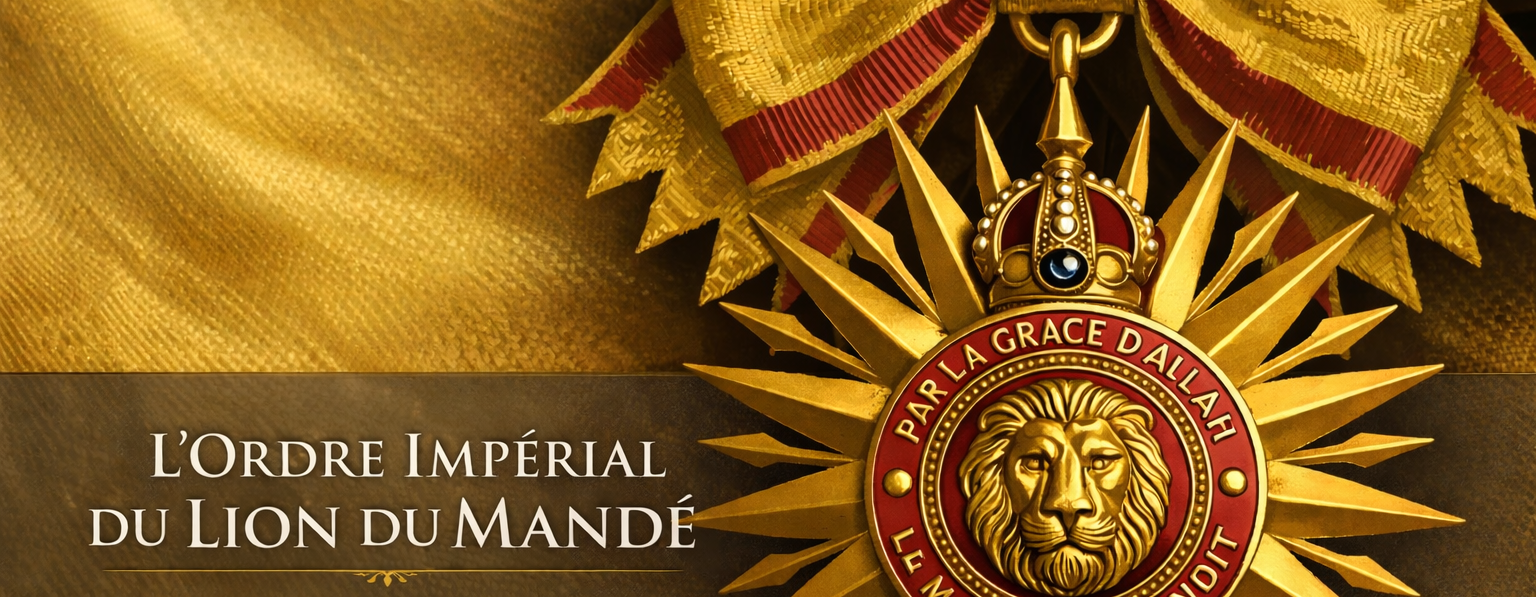
Historical context of the Imperial Order of the Lion of Mandé
The Imperial Order of the Lion of Mandé: Heritage and Renaissance of a Centuries-Old Tradition
The Imperial Order of the Lion of Mandé draws its roots from a thousand-year-old tradition, dating back to the golden age of the Empire of Mali. This order is directly inspired by the glorious heritage of the Donzo hunters, whose brotherhood, known as the Donzo Ton, was one of the founding pillars of Mandingo civilisation. These hunters, far more than simple warriors, embodied an ideal of bravery, justice and protection, structured around a strict code of honour: the Oath of the Hunters of Mandé. This oath, setting out principles of solidarity, respect and equity, constituted the moral foundation of the Charter of Kurukan Fuga, the founding text of the institutions of the Empire of Mali.

In the 13th century, Soundjata Keita, founder of the Empire of Mali, bore the title of Simbo, Grand Master of the hunters. This title was not merely honorary: it reflected his membership in the donzo brotherhood and his commitment to their values. Soundjata, an outstanding strategist, knew how to integrate this tradition into his political vision, making the hunters key actors in the unification of Mandé. Under the leadership of legendary figures such as Traoré and Kamara, the donzos played a decisive role in the victory over Soumaoro Kanté and the founding of the Empire in 1235, during the historic assembly of Kurukan Fuga. The donzos were much more than warriors. Experts of the forests, protectors of villages, they formed a solidarity network where one's word was a sworn oath. Their role went beyond the military framework: they were the guardians of traditions, mediators of conflicts and guarantors of social order. Even today, the donzo hunter brotherhoods perpetuate this heritage in West Africa, notably in Mali, Côte d'Ivoire, Burkina Faso and Guinea. Modernised but faithful to their roots, they continue to play a leading social and spiritual role, ensuring community security and the transmission of ancestral values.


The Sofa and the Mandekalu Cavalry: Pillars of the Imperial Army
The Sofa and the Mandekalu Cavalry were essential elite units of the imperial army of Mali in the 13th and 14th centuries. Originally servants of the Mandingo nobility, the sofa transformed into professional soldiers, tasked with combat missions and the protection of sovereigns. Their discipline and loyalty were exemplary, and they were feared for their shock infantry tactics. For example, in the 14th century, sofa were recruited as personal guards in the kingdom of Songhai. The Mandekalu cavalry, for its part, constituted the mounted elite, equipped for rapid and devastating charges, and mastered equestrian warfare with great precision. During the Battle of Kirina in 1235, it played a decisive role in Soundjata Keita's victory over Soumaoro Kanté. Together, the sofa and the Mandekalu cavalry allowed the Empire of Mali to dominate its enemies, combining infantry and cavalry to exploit enemy weaknesses and demonstrate great tactical mobility. These units enjoyed a reputation that extended beyond the empire's borders. African sovereigns, such as those of the kingdom of Bornu or Ghana, sought their services to strengthen their armies or ensure their security. The legacy of the sofa and the Mandekalu cavalry embodies the discipline, loyalty and excellence that made the empire great, remaining symbols of its military power and strategic ingenuity.


The Imperial Order of the Lion of Mandé: A Contemporary Renaissance
The Imperial Order of the Lion of Mandé is part of the continuity of this glorious tradition, drawing its legitimacy from the immemorial link between imperial power and the bodies of defenders invested with a mission of honour and protection. Its dynastic nature derives directly from the heritage of Soundjata Keita and the Oath of the Hunters of Mandé of 1222. Far from being a simple honorary distinction, this order reactivates, highlights and perpetuates a heritage rooted in the very foundations of the Empire of Mali. Based on legitimate authority, historical continuity and a body of unchanging values, the Imperial Order of the Lion of Mandé fully meets the academic criteria of a valid dynastic order. It is distinguished by its role in recognising and encouraging merit in the service of the community, while reaffirming the ideals of courage, justice and fidelity that shaped one of the greatest African civilisations.
A Living Heritage
The Imperial Order of the Lion of Mandé is not only a tribute to the greatness of the Empire of Mali, it is also a beacon that illuminates the timeless values of honour, bravery, justice and loyalty. Heir to the traditions of the donzo hunters and the elite military forces that shaped the empire, this order today stands as a living symbol of the continuity of a common ideal, that of unity and service to the community. It embodies both a renaissance of this noble tradition and an anchorage in contemporary reality, where its principles find an echo in a constantly evolving world. Through the Imperial Order of the Lion of Mandé, the thousand-year history of a prosperous empire and its ancestral wisdom are carried high, while inspiring future generations to continue this path of honour. This order, faithful to the foundations laid by Soundjata Keita and his successors, asserts itself not only as a recognition of individual merits, but also as a call to commitment to the ideals of unity, solidarity and human dignity. Today, just as yesterday, the Imperial Order of the Lion of Mandé continues to strengthen the bonds of heritage and culture, by honouring those who work for the well-being of the community and the influence of Mandingo civilisation throughout the world.
Manden Donsolu Kalikan
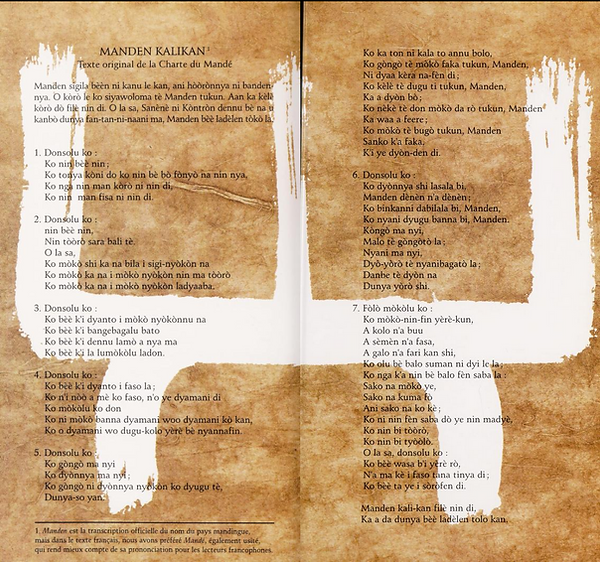
"Every life is a life…" The hunters of Manden
In 1222, five hundred and sixty-seven years before the Declaration of the Rights of Man, on the day of Soundiata Keita's enthronement as emperor of Mali, the Manden (or Mandé) Charter was sung in the Mandingue country. The empire of Mali, then at its peak, stretched from the Atlantic Ocean to the Niger. It enjoyed great prosperity thanks to the intensification of trade. The exceptional peace and freedom that reigned there, according to historians, were due to this Charter, a model of humanism and tolerance.
The Oath or Code of the Hunters of Mandé transcribed
Every life is a life.
It is true that one life appears in existence before another life,
But one life is not more "ancient", more respectable than another life,
Just as one life is not superior to another life.
The hunters declare:
Every life being a life,
Any harm caused to a life requires reparation.
Therefore,
Let no one gratuitously attack their neighbour,
Let no one harm their fellow human being,
Let no one torment their fellow creature.
The hunters declare:
Let everyone watch over their neighbour,
Let everyone venerate their parents,
Let everyone educate their children as they should,
Let everyone "maintain", provide for the needs of their family members.
The hunters declare:
Let everyone watch over the land of their fathers.
By country or homeland, faso,
We must also and especially understand the people;
For "any country, any land that would see men disappear from its surface would immediately become nostalgic."
The hunters declare:
Hunger is not a good thing,
Slavery is also not a good thing;
There is no worse calamity than these things in this world.
As long as we hold the quiver and the bow,
Hunger will no longer kill anyone in Manden,
If famine were to strike;
War will never again destroy a village
To take slaves from it;
That is to say that no one will henceforth put the bit in the mouth of their fellow human being
To go and sell them;
No one will be beaten either,
Still less put to death,
Because they are the child of a slave.
The hunters declare:
The essence of slavery is extinguished this day,
"From one wall to the other", from one border to the other of Manden;
The raid is banned from this day forward in Manden;
The torments born of these horrors are finished from this day forward in Manden.
What an ordeal is torment!
Especially when the oppressed have no recourse.
The slave enjoys no consideration,
Nowhere in the world.
The people of old tell us:
"Man as an individual
Made of bone and flesh,
Of marrow and nerve,
Of skin covered with hair and head hair,
Feeds on food and drink;
But his soul, his spirit lives on three things:
Seeing what he wants to see,
Saying what he wants to say,
And doing what he wants to do;
If just one of these things were missing from the human soul,
It would suffer.
It would surely wither."
Consequently, the hunters declare:
Everyone henceforth has control over their own person,
Everyone is free in their actions,
Everyone henceforth has control over the fruits of their labour.
Such is the oath of Manden
Addressed to the ears of the whole world.
The Imperial Order of the Lion of Mandé
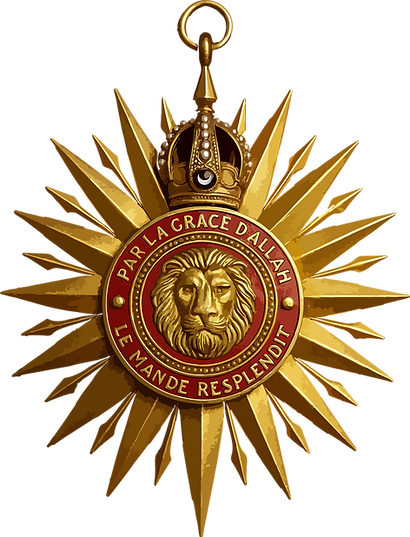
The Imperial Order of the Lion of Mandé, created on 5 January 2025, is based on the fons honorum of the Mansaren of Mandé and is attached to the Keita Imperial Dynasty, former ruling family of the Empire of Mali. Its legitimacy derives from Article 8 of the Charter of Kurukan Fuga, inscribed on the UNESCO intangible heritage list in 2009 by the Republic of Mali, which states: "The Keita Family is designated as ruling over the Empire," as well as from the Act of Proclamation of the coronation of the Mansaren of Mandé signed in December 2023 by the principal traditional chiefs of Mandé. This contemporary dynastic order rewards eminent merits rendered to the House of Mandé, honouring remarkable contributions in the cultural, artistic, historical, humanitarian or political fields. It distinguishes actions that preserve and promote the heritage of Mandé, support the Mandingo community around the world, and provide valuable aid to communities in need internationally. The motto of the Order is translated into three languages: Bambara, Arabic and French: "Ala ka here la, Mandé be nafa," "بفضل الله، يشرق الماندى" (Bi-fadli Allah, yashruqu al-Mandé), "By the grace of Allah, Mandé shines." The President and Head of the House of Mandé is the Simbo or Grand Master of the Order. The Order is administered by the Kalisa Farma or Grand Chancellor of the Treasury of the House of Mandé, assisted by the Council of the Order. Its organisation and administration have been governed since 5 January 2025 by the Code of the Lion of Mandé. The Imperial Order of the Lion of Mandé comprises three grades (Article R6): MEMBER – COMPANION – DIGNITARY, and two dignities: GRAND COMPANION – GRAND DIGNITARY. Appointments or promotions within the Imperial Order of the Lion of Mandé are made by the President and Head of the House of Mandé upon proposal of the various centralised committees of the Grand Chancellery.
Standard admission conditions
To be admitted to the grade of Member, one must have rendered eminent services for the benefit of the House of Mandé for a minimum of 2 years. A period of 2 years must separate an appointment or promotion in the Imperial Order of the Lion of Mandé. A person decorated with the Order of the Lion of Mandé may directly aspire to promotion to the higher grade after 2 years of seniority.
Wearing of decorations on the uniform
Grand Dignitary
Grand Companion
Dignitary
Companion
Member

Heraldic Privilege of the Order
